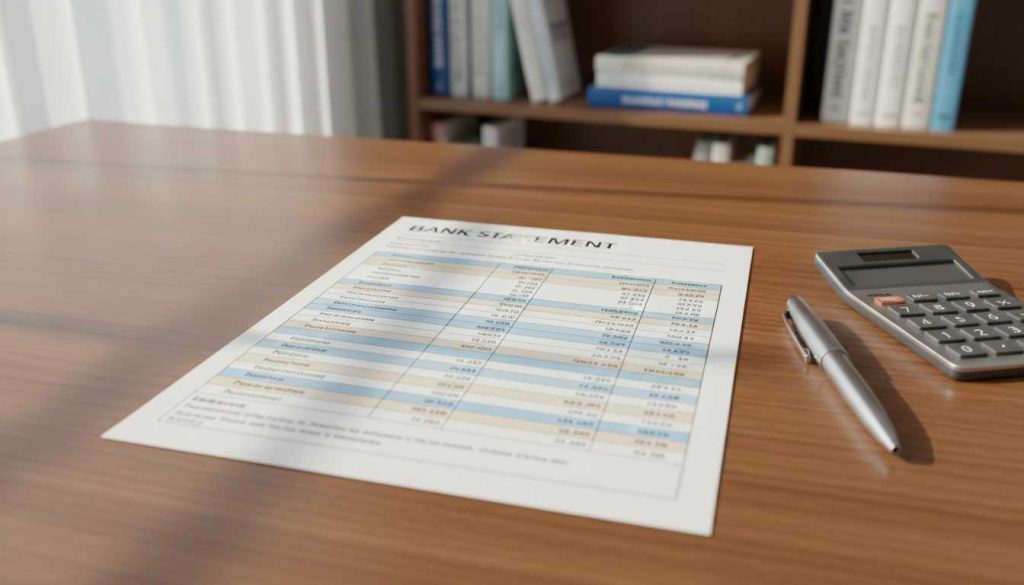
Bank Statement Translation: Keeping Tables Clean and Readable
Bank statement translation formatting matters just as much as the wording itself. When a statement is being reviewed for a visa file, mortgage application, audit, university requirement, legal matter, or compliance check, the reader needs to move across the page quickly without guessing which figure belongs to which date, description, or balance. A readable translation does not “improve” the original; it makes the original easier to verify. That is the real standard to aim for.
A strong bank statement translation should preserve table integrity, keep column alignment consistent, protect totals, and make transaction descriptions understandable without turning the page into a redesign project. The goal is not to create a prettier statement but to produce a translation that lets a caseworker, solicitor, lender, or admissions officer compare source and translation line by line with confidence.
If your bank statement is going to be submitted formally, it is worth handling the formatting with the same care as the terminology. One missing minus sign, one drifting balance, or one transaction description placed in the wrong row can create questions that slow everything down.
Why Bank Statements Are Harder to Translate Than Many Other Documents
Bank statements look simple until you have to translate them properly. Most statements combine several elements at once:
- Repeated table structures across multiple pages
- Date formats that may change by country
- Debit and credit columns
- Running balances
- Transaction references
- Bank-generated abbreviations
- Currency symbols
- Notes, footers, disclaimers, and page totals
The wording is only one layer. The real challenge is keeping every element connected to the correct row and the correct amount.
A bank statement is also one of the few common documents where formatting errors can look like content errors. If a translated description slips one line down, the reader may assume the wrong payment belongs to the wrong amount. If a balance is no longer visually tied to its row, the page becomes harder to verify. If column widths collapse, the statement may still be translated, but it is no longer comfortably reviewable. That is why good formatting is not cosmetic; it is evidence handling.
What “Clean and Readable” Should Mean in Practice
A clean bank statement translation usually has four qualities:
1. The Structure Mirrors the Source
The translation should follow the same overall order as the original statement:
- Account holder details
- Statement period
- Opening balance
- Transaction table
- Closing balance
- Notes or declarations
The exact visual design does not need to be copied pixel for pixel. What matters is that the translated version stays easy to compare against the source.
2. Each Row Stays Traceable
Each transaction should remain tied to its own:
- Date
- Description
- Debit or credit amount
- Running balance
- Reference number, where shown
If the reader has to stop and ask, “Which balance belongs to this line?”, the formatting is already failing.
3. Amounts Stay Visually Stable
Financial figures should never drift around the page. Right alignment or decimal alignment is often the safest approach because it helps the eye compare figures vertically. This becomes even more important when statements contain many rows or mixed positive and negative values.
4. Translated Text Remains Readable Without Overcrowding the Table
English can expand compared with the source language. A short banking term in one language may become a longer phrase in another. The solution is not to shrink the text until it looks compressed and difficult to read. The better approach is controlled expansion: adjust cell height, widen the description field where possible, and keep amount columns protected.
The Best Rule for Bank Statement Tables: Preserve Function Before Appearance
This principle separates a dependable financial translation from a rushed one. When translating a bank statement table, the most important question is not “Does it look identical?” It is: Can the reader still verify each entry quickly and confidently?
That means preserving the function of the table:
- Dates remain in a date column
- Descriptions remain in a description column
- Outgoing and incoming amounts remain distinct
- Balances remain attached to the correct row
- Page order remains intact
If a designer-style recreation makes the statement look polished but breaks that function, it is the wrong solution.
Column Alignment: Where Clarity is Won or Lost
Column alignment is one of the biggest factors in bank statement translation formatting, and it is often mishandled.
Dates
Dates should be kept in a single consistent format throughout the translation. Do not switch between formats halfway through the document. Where ambiguity could arise, use a clear style that removes doubt. For example, if the source uses a format that could be read in more than one way, the translated version should make the intended reading obvious while keeping the original date accurate.
Transaction Descriptions
Descriptions should usually be left aligned because they are text-heavy and easier to scan that way. If the bank uses short codes, references, or mixed uppercase strings, those should be handled carefully rather than casually normalized. Examples include:
- Card purchase references
- ATM withdrawal labels
- Transfer identifiers
- Branch codes
- Salary references
- Standing order markers
The translation should explain meaning without stripping away the original trace markers that help identify the entry.
Debit, Credit, and Balance Columns
Amounts should be aligned consistently from top to bottom. In practice, that usually means right alignment. This helps with:
- Rapid comparison between figures
- Spotting missing digits
- Checking repeated amounts
- Tracking running balance movement
When columns contain both text and figures, the figures should still be visually protected from crowding.
Transaction Descriptions: Translate Meaning, Keep Identifiers
Transaction descriptions are where many statement translations become either too vague or too intrusive. A good translation does two things at once: it translates the meaning of the transaction label and preserves the identifying reference information that the original bank statement contains.
For example, a bank-generated label may include:
- Merchant name
- Partial card number
- Transfer ID
- Branch reference
- Payment type
- Date/time stamp
- Automated code
These elements should not be casually deleted because they help the receiving authority cross-check the entry. At the same time, not every code needs to be “translated” as though it were prose. Codes often need to be retained exactly, while the surrounding wording is translated.
A practical approach is to translate descriptive words, retain alphanumeric identifiers exactly, preserve separators where they support readability, and avoid rewriting merchant names unless there is a clear reason.
Example Approach
Poorly handled: Transfer completed successfully
Better handled: Online transfer completed – Ref. 8F29K1 / Branch Code 441
The second version gives the reader more to work with and stays closer to the source record.
Totals Checks Matter More Than People Think
Bank statement tables do not only need to look neat; they need to survive a basic mathematical read-through. That means checking:
- Opening balance
- Closing balance
- Row-by-row running balance
- Daily or page totals where shown
- Debit and credit positioning
- Negative sign placement
- Currency consistency
A table can appear tidy while still containing a silent formatting problem. A minus sign can disappear. A debit can be pushed into the wrong column. A running balance can line up with the next row. These are not simply stylistic mistakes; they can change how the document is interpreted.
The Three-Pass Review Method for Bank Statement Translations
A useful way to reduce risk is to review the statement in three separate passes.
Pass One: Row Check
Read every row across: date, description, amount, balance. This confirms that nothing has slipped into the wrong line.
Pass Two: Column Check
Read each column vertically: all dates together, all debit figures together, all credit figures together, all balances together. This helps expose alignment drift, inconsistent formatting, or a misplaced figure.
Pass Three: Balance Logic Check
Check whether the sequence of entries still makes sense from opening balance to closing balance. You are not auditing the bank; you are confirming that the translated layout has not introduced confusion. This three-pass method is simple, but it catches many of the errors that create unnecessary follow-up questions later.
When English Text Becomes Longer Than the Original
This is common, especially when translating from languages that use compact banking abbreviations. The wrong response is to compress everything into the existing width until the table looks cramped. The better options are:
- Increase row height
- Widen the description column
- Wrap text cleanly within the cell
- Move long explanatory notes below the row only when absolutely necessary
- Protect numeric columns from being squeezed
Readability should win over rigid imitation. A receiving authority does not benefit from a statement that looks visually identical but forces them to squint through dense, broken text.
Multi-Page Statements Need Disciplined Formatting
Many bank statements run across several pages, and this is where consistency becomes essential. On longer statements, the translation should keep:
- Repeated headers where helpful
- Stable column order
- Consistent date style
- Consistent currency display
- Clear page sequencing
- Notes about any unreadable or cut-off source text
If the source has page numbers, keep page numbering easy to follow. If the source includes monthly sections, preserve those section breaks. If a table continues onto another page, the translation should not make it feel like a new table unless the original clearly does.
What to Do with Unreadable Scans, Cropped Rows, and Poor PDFs
Some formatting problems begin before translation starts. Common issues include:
- Blurred scans
- Phone images taken at an angle
- Cropped margins
- Shadows across balances
- Low-resolution PDF exports
- Cut-off footer notes
- Dark backgrounds that obscure transaction lines
When the source is unclear, the translation should not guess. It should flag uncertainty properly and request a better scan if needed. This is especially important with:
- Balances
- Negative figures
- Transaction references
- Stamped notes
- Page-end totals
For faster turnaround and cleaner formatting, submit:
- A flat scan or high-resolution PDF
- Full page edges
- No fingers, shadows, or folds
- All pages in the correct order
- The clearest version available from online banking or official download
A better source file usually leads to a cleaner translation, fewer queries, and a faster final check.
Certified Bank Statement Translations Need More Than Accurate Wording
For formal submissions, the translation may also need certification wording, date, translator details, signature handling, and a format that can be checked independently by the receiving body. UK government guidance states that documents submitted in support of an application that are not in English or Welsh should be accompanied by a full translation, and certification guidance asks for a statement that the translation is true and accurate, plus the date and translator details. Industry guidance from ATC, ITI, and CIOL also notes that UK practice allows formatting leeway, including replicating tables and font styles where useful, rather than forcing a rigid line-by-line format.
That is why a bank statement translation intended for official use should be handled as a document package, not just a block of translated text. The table must remain readable, but the certification layer must also be complete.
Common Mistakes That Make Bank Statement Translations Harder to Trust
Rebuilding the Table from Scratch Without Enough Control
This can produce a document that looks modern but no longer matches the source line by line.
Merging Debit and Credit into One Column
Readers then have to infer direction from context, which slows review and increases risk.
Dropping Repeated Transaction References
These may look unimportant, but they often help identify the exact entry.
Translating Codes That Should Be Retained
Not every code is prose. Some items should remain exactly as shown.
Letting Text Push Numbers Out of Place
Once numeric columns lose stability, confidence drops quickly.
Fixing the Source Instead of Translating It
A translator should not silently “correct” bank wording, reorder entries, or tidy a statement into a different document.
A Practical Formatting Checklist Before Submission
Before a bank statement translation is delivered, check that:
- Every page of the source has been translated
- The statement period is clearly shown
- Account holder details match the source
- Column order is consistent
- Dates are consistently formatted
- Debit and credit values are distinct
- Balances remain aligned with the correct rows
- Transaction descriptions are understandable
- References and codes are preserved where needed
- Opening and closing balances are easy to identify
- Any unclear source text is flagged, not guessed
- Certification details are included when required
This kind of checklist is what turns a readable translation into a submission-ready one.
Why This Matters for Visas, Lending, Compliance, and Legal Work
Different organisations review bank statements for different reasons, but they all want the same basic thing: a document they can follow without hesitation. A visa officer may want to confirm financial history. A lender may want to assess account activity and balance consistency. A solicitor may need supporting financial evidence. A university or regulator may need proof of funds or account ownership.
In each case, clarity reduces friction. The easier your translated bank statement is to read, the less chance there is of avoidable questions about figures, rows, or authenticity.
Work with a Team That Understands Both Language and Document Control
Bank statements should not be treated like generic text files. They are structured financial records. That means the translation needs linguistic accuracy, financial awareness, and careful formatting discipline from the first page to the last.
If your statement will be reviewed for an application, claim, legal file, or official submission, send the clearest copy you have and ask for a version that preserves table integrity rather than flattening everything into plain text. Upload your file, request your quote, and get your bank statement translated in a format that is clear, checkable, and ready to use.
“Their quality and customer care levels are amongst the best we have encountered in the industry.” TS24’s reviews page attributes that feedback to British Petroleum, and the company also presents its financial translation, certified translation, quote, and review pages as part of the same service journey.
Frequently Asked Questions
Does Every Transaction Need to Be Translated on a Bank Statement?
If the statement is being used for official review, the safest approach is a full translation rather than a summary. A reviewer may need to understand the meaning of each line, including transaction descriptions, amounts, references, and balances.
Should a Bank Statement Translation Keep the Original Table Layout?
It should keep the original table logic. That means preserving row order, column function, and balance traceability. The exact design does not need to be copied perfectly, but the translated table should remain easy to compare with the source.
What is the Most Important Part of Bank Statement Translation Formatting?
Column integrity. If dates, descriptions, debit or credit amounts, and balances are not visually stable, the whole statement becomes harder to verify.
Can Transaction Descriptions Be Shortened in Translation?
Only with care. You can make wording clear and readable, but you should not remove useful identifying references or reduce the description so much that the original meaning becomes harder to trace.
Do I Need a Certified Translation of My Bank Statement?
That depends on the authority receiving it. For UK official purposes, check whether the organisation requires a certified translation and whether it has specific rules on translator details, signatures, or digital copies. UK government guidance and professional body guidance both set out the standard information normally expected on certified translations.
Can a Scanned PDF Bank Statement Still Be Translated Accurately?
Yes, if the scan is clear. High-resolution PDFs usually produce better results than dark photos, cropped screenshots, or blurry mobile images. Clear source files make it much easier to preserve tables, figures, and page order accurately.