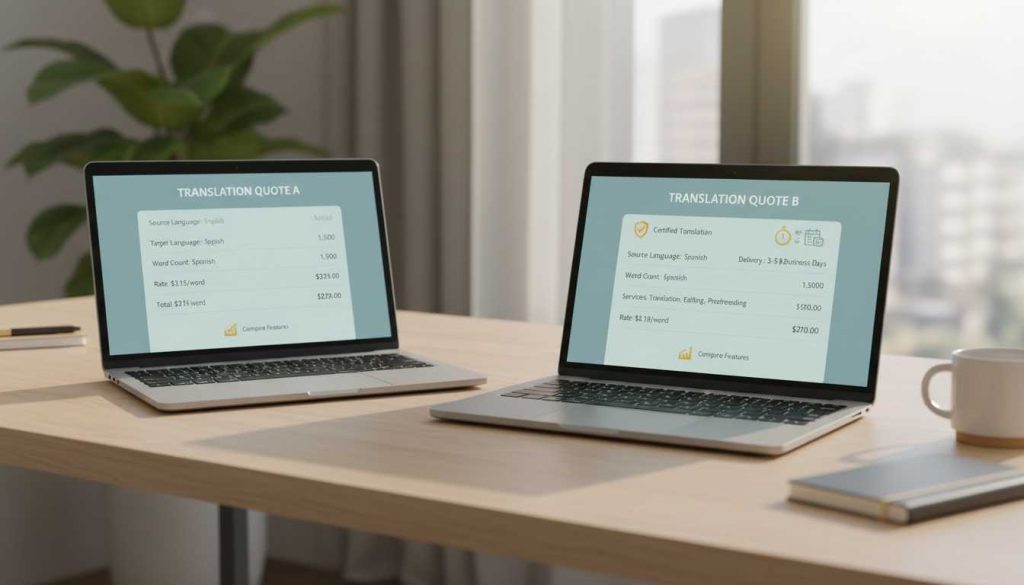
When you request quotes from two different translation providers, you may receive two very different responses. One quote may seem inexpensive, while the other appears more comprehensive. One may include certification, while another may only offer translation. One might promise delivery tomorrow, but without specifying whether that means a PDF, hard copy, or both. At first glance, one quote may seem higher, but it could already encompass the items that the cheaper quote will add later.
This is where many individuals make the wrong decision. The issue often lies not in the numbers themselves but in the fact that they describe different services. To effectively compare translation quotes, you must ensure that you are evaluating the same job, with identical requirements, deadlines, and delivery expectations. Otherwise, you are merely comparing packaging rather than value.
The cheapest quote is only the cheapest if it includes the services you actually need. If your document is intended for official use, begin by verifying what a complete certified package should contain using a certified translation UK checklist. If you know your document will be submitted to immigration or court, it is also beneficial to review the specific guidance on UKVI translation requirements and HMCTS translation requirements.
If you need a fixed quote that you can genuinely compare, send the file first, indicate where it will be submitted, and request one complete price that includes certification, turnaround, revisions, and delivery method confirmed upfront.
The short answer
To compare translation quotes properly, ensure that all of the following match:
- The same document scope
- The same certification level
- The same turnaround deadline
- The same revision policy
- The same delivery method
- The same treatment of formatting, stamps, seals, and handwritten notes
- The same responsibility for quality control
- The same extras and hidden fees
If even one of these factors changes, the quote is no longer directly comparable.
Why translation quotes often look so different
Translation is not a one-size-fits-all product. A quote can vary due to several factors, including:
- The language pair
- Document type
- Word count or page count
- File quality
- Urgency
- Certification included or not
- Second review included or not
- Delivery format
- Number of pages with stamps, tables, notes, or attachments
- Whether the provider is pricing the entire job or just the base translation
This variability explains why two providers can both appear reasonable while providing very different totals. One may quote for translation only, while another may quote for a submission-ready package. These are not equivalent purchases.
The first question to ask before you compare price
What is this translation actually for?
Before comparing numbers, define the use case in one sentence. For example:
- This is for a UK visa application.
- This is for court use.
- This is for university admissions.
- This is for internal business reference only.
- This is for a landlord, solicitor, or employer.
This single sentence can significantly impact the quotes you receive. A standard translation for reference use is not the same as a certified translation for official submission. A court pack with annexes differs from a one-page certificate. A same-day quote is not directly comparable to a three-day quote. A savvy buyer compares quotes only after the purpose is clearly established.
The apples-to-apples checklist
1. Check whether certification is included
This is one of the primary reasons quotes can appear deceptively different. Some providers quote for:
- Translation only
Others quote for:
- Translation plus certification statement
Some may include:
- Translation
- Certification
- Signature and date
- Contact details
- Formatted PDF
- Optional hard copy
If your document is for official use, ask the provider to clarify whether certification is included in the price.
What to ask
- Is this quote for standard translation or certified translation?
- Is the certification statement included?
- Is the signed and dated declaration included?
- Are contact details included on the certification page?
- Is the quote for a full submission-ready package or just the translated text?
What often goes wrong
A buyer may see a lower quote and assume both providers are offering the same service. Later, an “extra” charge appears for certification, formatting, or official delivery. For documents intended for official use, this is not a minor detail; it can mean the difference between a usable and unusable document.
2. Make sure the same document scope is being priced
A translation quote is only comparable if both providers are pricing the same material. This means asking:
- Are all pages included?
- Are back pages included?
- Are stamps, seals, handwritten notes, marginal notes, and annexes included?
- Are tables, headings, and reference numbers included?
- Is the quote based on what was actually uploaded, or on an assumption?
A common trap
One provider may price the visible main page only, while another prices:
- The front page
- The reverse side
- The registration box
- The stamp
- The handwritten note
- The attached page
The second quote may appear higher, but it could be the only one that covers the actual job. If the source file is incomplete, blurred, cropped, or missing pages, a responsible provider should flag that before quoting. This alone often indicates better project handling.
3. Compare turnaround properly, not loosely
“24 hours” sounds straightforward, but it often is not. You need to clarify:
- When does the clock start?
- Is the deadline based on business hours only?
- Is certification included within that timeframe?
- Does the quote include review time?
- Does delivery mean draft, final PDF, or posted hard copy?
Turnaround is only comparable when the finish line is the same
A quote promising delivery “today” may still be less useful than one promising “tomorrow by 10am with certification and final PDF included.” Speed without definition creates risk.
What to ask
- What is the exact delivery time?
- Is that for the finished certified version?
- Is revision time included?
- Are same-day or weekend fees built into this quote?
- Is physical delivery included or separate?
For buyers on a deadline, vague turnaround language is often more dangerous than a higher price.
4. Check whether revisions are included
Every serious buyer should understand what happens after delivery. Ask:
- Are corrections included if there is an issue?
- Is there one revision round included?
- Are formatting adjustments included?
- If the receiving body requests a minor correction, is that covered?
- Is the revision window limited?
Why this matters
A low quote may seem appealing until you realize that every post-delivery change is billable. This can become costly quickly if:
- A name needs to match the source format
- The PDF requires clearer labeling
- The certificate page needs updating
- A page was missed due to an unclear scan
A quote that includes revisions is often better value than a cheaper quote with rigid exclusions.
5. Check the delivery method, not just the delivery date
“Delivered” can mean very different things. It might refer to:
- Editable Word file
- PDF by email
- Scanned certified PDF
- Printed hard copy by post
- Couriered originals and hard copies
- Digital only
Delivery method changes usefulness
If your authority accepts PDF, digital delivery may suffice. However, if your recipient requires a paper copy, a cheap digital-only quote is not comparable to one that includes printing and postage.
What to ask
- Will I receive PDF, Word, or both?
- Is a printed hard copy included?
- Is postage included?
- Is courier delivery available if needed?
- Will the file be clearly labeled for submission?
For official-use translations, delivery is part of the product, not an afterthought.
6. Ask how the provider handles formatting, stamps, seals, and notes
A translation quote may or may not include layout work, which is more significant than many buyers expect. An official-use translation often requires clear handling of:
- Stamps
- Seals
- Handwritten text
- Signatures
- Tables
- Logos
- Annotations
- Crossed-out text
- Attached pages
Why this matters
A provider can technically translate the words but still deliver a file that feels incomplete, hard to verify, or awkward to submit. This is where superior providers distinguish themselves. They do not just translate the text; they make the document easier to trust.
7. Check who is doing the quality control
Not every quote includes the same review process. Some jobs are priced as:
- Translator only
Others are priced as:
- Translation
- Internal review
- Formatting check
- Certification check
- Project management
The right question is not “Do you check quality?”
The right question is: What quality steps are included in this quote? Ask whether the provider checks:
- Names
- Dates
- Reference numbers
- Page completeness
- Consistency across pages
- Certificate details
- Layout for submission use
For private notes or internal memos, a lighter workflow may be acceptable. However, for court, immigration, academic, or legal documents, it usually is not.
8. Look for hidden extras that distort the comparison
A low headline price can conceal a long list of add-ons. Common extras include:
- Certification fee
- Urgent turnaround fee
- Second-review fee
- Formatting or DTP fee
- Hard copy fee
- Postage or courier fee
- Notarisation fee
- Project management fee
- Minimum charge
- Difficult handwriting surcharge
A better way to compare
Request each provider to provide one complete price for the job as delivered. This should encompass:
- Translation
- Certification if required
- Turnaround
- Revisions policy
- Delivery method
- Any known extras
A provider who can clearly explain the full price is typically easier to work with from the outset.
Side-by-side comparison table
| Comparison point | Quote A | Quote B | What actually matters |
|---|---|---|---|
| Certification included | Yes/No | Yes/No | A lower quote without certification is not comparable for official use |
| Scope covered | Pages listed | Pages listed | Confirm full document, stamps, notes, annexes, back pages |
| Turnaround | Exact time | Exact time | Compare finished certified delivery, not vague promises |
| Revisions | Included/Extra | Included/Extra | Post-delivery fixes can change total cost |
| Delivery method | PDF/Word/Post | PDF/Word/Post | Digital only is not equal to posted hard copy |
| Quality control | Basic/Reviewed | Basic/Reviewed | Review steps affect risk, especially for formal documents |
| Hidden extras | Listed | Listed | The base price is not the real price if extras are still to come |
| Submission fit | Standard/Official use | Standard/Official use | Match the quote to the actual purpose of the document |
A simple definition that helps
What is a comparable translation quote?
A comparable translation quote is one that matches another quote on:
- Service type
- Document scope
- Certification included
- Turnaround
- Revisions
- Delivery
- Total cost
If any of these factors differ, you do not yet have a true comparison.
Three examples that show why buyers get misled
Example 1: One-page birth certificate for UKVI
Quote A: Lower price, translation only, no certificate mentioned, digital file only. Quote B: Slightly higher price, certified translation, signed statement, same-day PDF. For a UKVI submission, Quote B is usually the real comparison point. The lower quote is not cheaper; it is incomplete for the job.
Example 2: Eight-page court order with annexes
Quote A: Low per-page rate, no mention of annexes, no reference to seals, no delivery detail. Quote B: Higher fixed fee, all pages included, annexes included, certification page included, court-friendly PDF. For legal use, Quote B may save both time and rework. The price difference often reflects the difference between “translated” and “filing-ready.”
Example 3: Internal business memo for reference
Quote A: Standard translation, no certification, 48-hour delivery. Quote B: Certified translation, formal PDF, extra review, hard copy option. Here, Quote A may be perfectly appropriate because the document is not being submitted to an authority. The better quote depends on the purpose, not the label.
The 60-second quote test
Before accepting any quote, run this quick test.
Can you answer all six questions in under a minute?
- What exactly is being translated?
- Is certification included?
- When will the final version be delivered?
- What happens if I need a correction?
- What format will I receive?
- What is the full price with no surprises?
If you cannot answer all six questions from the quote itself, it is not a clean quote yet.
The questions smart buyers send before paying
Copy, paste, and send this:
“Please confirm whether your quote includes the full document, certification if required, signature and date, revisions, and final delivery format. Please also confirm whether any extra charges may apply for urgency, formatting, hard copy, or missing visible content such as stamps, seals, handwritten notes, or annexes.”
This single message eliminates a significant amount of ambiguity.
Red flags in a quote that looks cheaper than everyone else
Be cautious if the quote:
- Does not specify whether certification is included
- Gives no exact delivery time
- Does not define the delivery method
- Avoids mentioning revisions
- Says “from” but not “for this file”
- Prices only a page count without checking the file
- Ignores stamps, handwritten notes, annexes, or poor scan quality
- Adds several small service fees after the headline rate
- Sounds fast but does not explain what is delivered at that speed
A very low quote is not automatically bad, but it should be examined more closely, especially when the document is critical for a caseworker, registrar, solicitor, court, or university.
When paying more is usually worth it
A stronger quote is often worth the extra cost when:
- The document is for UKVI or Home Office use
- The document is for court or legal proceedings
- The file contains stamps, notes, tables, or annexes
- The deadline is tight
- Accuracy matters beyond simple reading
- You need a polished PDF for submission
- You do not want to order twice
In these cases, a complete fixed quote usually outweighs a bargain rate with missing components.
When the lower quote may be absolutely fine
The cheaper quote may be the right choice when:
- The translation is for personal reference only
- No certification is needed
- Formatting is not important
- You are not under time pressure
- The document is simple and low risk
- Digital text alone is sufficient
This is the key point many buyers overlook: cheap is not wrong; cheap for the wrong service is wrong.
A better buying rule than “Who is cheapest?”
Instead, ask: Who has quoted the same job, clearly, completely, and with the least risk of rework? This is how experienced buyers compare translation quotes. They do not merely compare numbers; they compare outcomes.
An illustrative case-style example
A buyer receives two quotes for a marriage certificate and supporting registry page. The first quote appears cheaper by £18 but excludes certification and does not mention the reverse-side registry note. The second quote includes:
- Full translation of both sides
- Certification statement
- Signed and dated PDF
- One round of minor corrections
- 24-hour delivery
The buyer chooses the second quote. Why? Because it is the only quote that matches the real submission need. This is what comparing quotes properly looks like in practice.
What a good quote should feel like
A good quote should feel:
- Clear
- Complete
- Specific
- Calm
- Easy to approve
It should not leave you guessing about:
- What is included
- What costs extra
- What you will receive
- Whether the translation is ready for its intended use
If it does, ask for the missing details before you pay.
The best way to get a quote you can trust
Send the actual file, specify the destination, and state the deadline. A useful request looks like this:
- Document attached
- Target language needed
- Purpose of the document
- Date you need the final version
- Whether you need PDF only or hard copy too
This approach makes it much easier to receive a quote you can compare fairly. If you want a straightforward price for a complete job rather than a teaser rate, send your document through the contact page or review the service scope on the main services page.
Final thought
The goal is not to find the lowest number. The aim is to purchase the right translation, at the right level, with the right delivery, for the right purpose. Once you compare certification included, turnaround, revisions, delivery method, and hidden extras on a like-for-like basis, the decision usually becomes much easier. And when a quote remains unclear, that is useful information too. A clear provider typically offers a clear quote. If you need a fixed price for an official-use document, send the file, specify where it is going, and request the full submission-ready cost in one line. This is the quickest way to stop comparing apples and oranges and start comparing real value.
FAQs
How do you compare translation quotes properly?
Compare translation quotes by matching the same service level across both providers: document scope, certification included, turnaround, revisions, delivery method, and total cost. If one quote includes certification and the other does not, they are not directly comparable.
Should a certified translation quote include certification in the price?
For official-use documents, it should be made explicit. A certified translation quote should clearly state whether the certification statement, signature, date, and contact details are included, rather than leaving them as later extras.
Why is one translation quote much cheaper than another?
A cheaper translation quote may exclude certification, formatting, revisions, hard copy delivery, or review steps. It may also cover fewer pages or omit stamps, handwritten notes, or annexes. The lower price is not always for the same job.
Are revisions usually included in translation quotes?
Not always. Some providers include minor corrections or one revision round, while others treat every change as an extra charge. Always ask what happens if a correction is needed after delivery.
Is digital delivery enough, or do I need a hard copy?
That depends on where the document is being submitted. Some recipients accept PDF only, while others may require a printed hard copy. A quote should clarify the delivery method so you know whether it fits your use case.
What should I ask before accepting a translation quote?
Ask whether the quote includes the full document, certification if required, revisions, exact turnaround, final delivery format, and any extra charges for urgency, formatting, postage, or hard copy.